
 By Philip
Ever wondered how inventors protect their ideas before getting a full patent? Is there a smart way to keep your ideas safe without spending a lot?
A provisional patent is not a full patent. It’s a temporary application that shows your invention’s date with the US Patent and Trademark Office (USPTO). This tool gives inventors a 12-month chance to work on and protect their ideas.
When you learn about provisional patents, you find a cheap way to claim your spot in the world of new ideas. It’s a first step. It lets creators keep their place in line while they make their idea better.
Key Takeaways
- Provisional patents provide temporary legal protection for inventions
- Establishes an official filing date with the USPTO
- Offers a 12-month window to develop and refine inventions
- More affordable than full patent applications
- Helps inventors test market before big investment
Understanding the Concept of Provisional Patents
Inventors often start with a USPTO provisional filing to protect their ideas. This gives them patent pending status without the need for a full patent. It’s a simpler way to start.
A provisional patent is a basic document filed with the USPTO. It marks the start of an invention’s journey. It gives inventors short term patent rights to work on their idea.
Key Definition of Provisional Patents
A provisional patent application is like a placeholder. It:
- Protects an invention for 12 months
- Allows inventors to use the term “patent pending”
- Provides a lower-cost entry into patent protection
- Preserves the chance for a full patent application later
Essential Features of Provisional Patents
Knowing what provisional patents are helps inventors. They need less detail than full patents but must describe the invention well.
Remember, a provisional patent isn’t forever. It’s a first step in the patent process. It gives temporary protection to work on and improve the invention.
The Benefits of Filing a Provisional Patent
Inventors have a great tool to protect their ideas: the provisional patent. It’s a smart way to keep your invention safe without spending a lot of money at first.
Provisional patents are a quick and cheap way to protect your idea. They let you get legal protection fast without the big costs of full patents.
Cost-Effective Protection Strategies
Provisional patents are great for inventors who don’t have a lot of money. They offer big savings. Here’s why:
- They cost much less to file than full patents
- They save on legal fees
- You have 12 months to see if your idea works
- They let you test your idea before spending more money
Establishing an Early Filing Date
Getting an early priority date is a big plus of provisional patents. It helps inventors in many ways:
- It gives you priority in patent applications
- It keeps others from copying your idea
- It gives you time to make your invention better
- It helps prepare for patents in other countries
Using provisional patents is a smart move. It helps protect your idea and keeps your options open. It’s a cost-effective way to turn your idea into something you can sell.
How to File for a Provisional Patent
Filing a provisional patent is a key step for inventors. It helps protect their ideas. The process has several important steps that need careful attention and detailed documents.
Inventors need to gather important documents for patent filing. These include:
- Comprehensive written description of the invention
- Detailed technical drawings
- Inventor contact information
- Unique invention title
Required Documentation
When filing a provisional patent, inventors must write a clear and thorough description of their invention. This description should cover:
- The technical aspects of the invention
- Potential variations and implementations
- Specific functional details
- Unique problem the invention solves
Step-by-Step Filing Process
The patent filing process is systematic. Inventors can follow these steps:
| Step | Action | Details |
|---|---|---|
| 1 | Document Preparation | Create a detailed invention description |
| 2 | Technical Drawings | Make detailed diagrams and illustrations |
| 3 | USPTO Submission | File online through the electronic system |
| 4 | Pay Filing Fee | Submit the required provisional patent fee |
Remember, a provisional patent offers 12 months of protection. This gives inventors time to improve their invention and explore its commercial value.
Provisional Patent vs. Non-Provisional Patent
Understanding the patent process is key. It’s important to know the difference between provisional and non-provisional patents. These options help inventors protect their ideas.
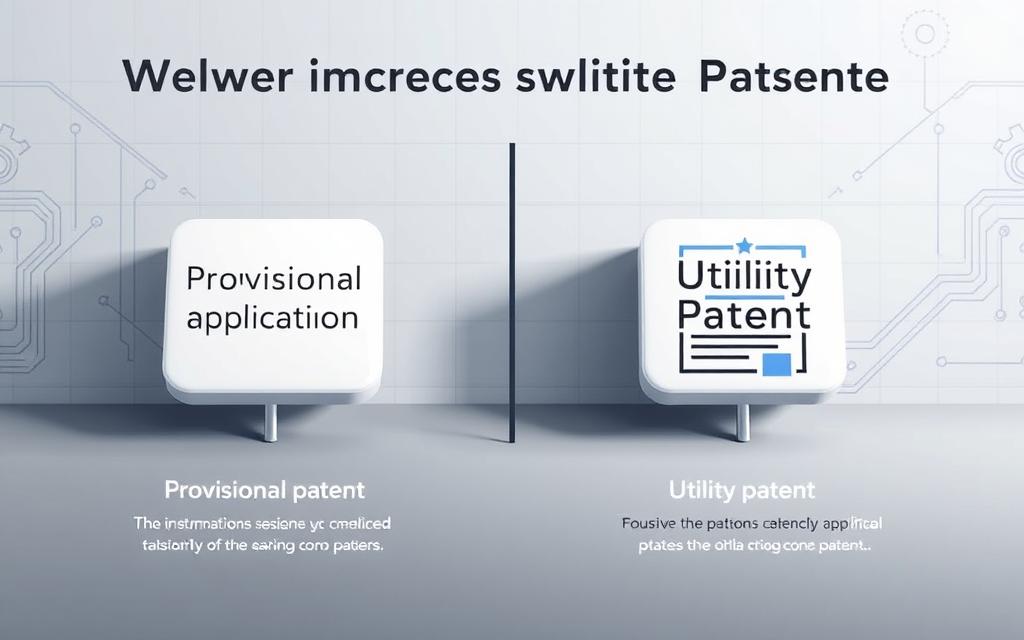
A provisional patent is a simpler way to start. It gives temporary protection without needing detailed patent claims. This is different from a non-provisional patent.
Key Differences Between Patent Types
- Filing Requirements: Provisional patents need less paperwork
- Non-provisional patents require more detailed technical info
- Provisional patents last 12 months, while non-provisional patents can last longer
Transitioning to a Non-Provisional Patent
When should you switch to a non-provisional patent? Consider these points:
- Your invention is fully developed
- You know it has market value
- You need more money or investor interest
- The 12-month provisional period is almost over
Switching means filing a full patent application. It includes detailed claims, drawings, and technical descriptions. This makes your initial protection stronger.
Duration and Renewal of Provisional Patents
Getting a patent needs careful planning. Provisional patents are key for 12 months to protect new ideas.
Provisional patents give temporary safety for inventions. This lets creators work on their ideas. They can check the market and get money without sharing their secrets.
Understanding Provisional Patent Validity
Provisional patents have important tips for use:
- Expires after exactly 12 months from the filing date
- Cannot be renewed or extended beyond the initial period
- Serves as a placeholder for future non-provisional patent application
Strategic Options After Expiration
When a provisional patent is about to end, inventors have choices:
- File a non-provisional patent application
- Abandon the invention protection
- Implement a rolling provisional application strategy
The rolling strategy is for quick changes in tech. It lets inventors keep updating and protecting their ideas. By filing new applications, they keep their work safe.
Keeping good records and filing on time is key. This helps get the most from provisional patents.
Common Misconceptions About Provisional Patents
Inventors often get things wrong about provisional patent applications. These forms can be tricky. Many creators make mistakes that hurt their rights.
Many inventors don’t get what provisional patents are. They think they offer the same protection as full patents. But that’s not true.
It’s Not a Full Patent
A provisional patent is like a temporary marker. It gives limited protection. Unlike a full patent, it doesn’t get a full review by the patent office. Here’s why:
- No formal patent claims
- 12-month temporary protection
- Lower filing requirements
- Serves as a priority document
Understanding Legal Rights
A provisional patent doesn’t give you full rights to your invention. It’s a first step in the patent process. It lets inventors:
- Establish an early filing date
- Protect the concept temporarily
- Secure time to develop the invention
- Prepare for a full patent application
Inventors need to know that provisional patents need careful work. Bad or incomplete info can hurt your legal protection. So, it’s important to be precise and detailed.
Importance of Patent Searches Before Filing
Protecting your new ideas is more than just being creative. A detailed patent search is key to keeping your ideas safe. It also boosts your chances of getting your patent approved.
Doing a deep patent search shows you what’s already out there. This is called a prior art search. It tells you if your idea is new and can get a patent.
Understanding Prior Art
A prior art search looks at patents, papers, and public talks about your invention. It checks if your idea can stand up to possible challenges.
- Examine existing patent databases
- Review scientific publications
- Analyze technical journals
- Investigate commercial products
Enhancing Patentability
A smart patent search can really help your application. It finds possible problems early. This lets you make your invention better and more unique.
| Search Strategy | Benefits |
|---|---|
| Comprehensive Database Review | Identifies similar existing patents |
| Global Patent Exploration | Reveals international competitive landscape |
| Technical Literature Analysis | Uncovers possible innovation gaps |
Inventors should do patent searches carefully. Strategic thoroughness is important. Professional services can give you insights you might miss on your own.
Costs Associated with Filing a Provisional Patent
Understanding the cost of filing a provisional patent is key for inventors. Knowing the provisional patent cost and USPTO filing rules is vital. It helps protect your ideas and keeps your budget in check.
The USPTO has a fee system based on who you are. This makes it easier for inventors of all sizes to protect their work.
Filing Fee Breakdown
Fees for patent filing depend on who you are. The USPTO has three main groups:
- Micro Entity: Lowest fee bracket
- Small Entity: Moderate fee structure
- Large Entity: Standard fee rate
Comprehensive Cost Analysis
When figuring out the cost of a provisional patent, think about more than just the filing fee:
| Cost Category | Estimated Range |
|---|---|
| USPTO Filing Fee | $70 – $300 |
| Professional Drawing Preparation | $300 – $800 |
| Legal Consultation | $1,000 – $3,000 |
| Total Estimated Cost | $1,370 – $4,100 |
Smart inventors plan a detailed budget for all costs of filing with the USPTO. Planning ahead can help control costs and protect your intellectual property.
Strategies for Successful Provisional Patent Applications
Creating a strong provisional patent application needs careful planning and detail. Inventors must know what makes their idea special to protect it well.
When making a provisional patent sample, focus on detailed documents. These should show what makes your invention unique. Here are some tips to make your application better:
- Develop extremely detailed technical descriptions
- Include multiple embodiments of your invention
- Provide clear technical drawings and diagrams
- Document experimental results and prototypes
Crafting Comprehensive Descriptions
A good provisional application needs lots of detailed information. Inventors should gather all the materials that show their invention’s newness. This includes:
- Precise technical specifications
- Functional explanations of the invention
- Potential manufacturing processes
- Comparative analysis with existing technologies
Creating Clear Patent Claims
Patent application tips say it’s key to have clear, specific claims. Your description should:
- Explain the unique problem your invention solves
- Highlight innovative technical features
- Demonstrate the invention’s practical applications
Patent lawyers suggest adding extra documents like research papers and lab notes. These help prove your invention is new and original.
Importance of Seeking Legal Advice

Understanding intellectual property protection is hard. A patent attorney helps inventors protect their ideas. They know how to use legal options to keep your invention safe.
Inventors face many challenges when protecting their ideas. A good patent attorney can help a lot. They offer:
- Deep knowledge of patent law
- Help figuring out if your invention can be patented
- Advice on how to protect your rights
- Help avoiding mistakes when filing
Selecting the Right Legal Partner
Finding the right patent attorney is important. Look for someone who knows your invention’s field well. Having the right knowledge can really help get your patent approved.
When choosing, think about these things:
- Do they know your invention’s field?
- Have they done many patent applications?
- Can they explain things clearly?
- Is their fee clear and fair?
Decoding Legal Complexity
Patent terms can be hard to understand. A good patent attorney makes it simple. They explain legal options so you can make smart choices.
Getting legal advice is a smart move. It’s an investment in your invention’s future. The right attorney can guide you through the patent world, protect your rights, and keep your ideas safe.
The Role of Provisional Patents in Startups
Starting a business is tough. You need to protect your ideas. A good startup patent strategy is key to success.
Provisional patents help a lot. They are cheap and protect your new ideas. This lets you work on your product while you get your patent.
Securing Investments Through Intellectual Property
Investors want to know if a startup is worth it. A strong patent strategy shows you’re different. It shows you’re serious about your product.
- Unique technological innovations
- Potential market differentiation
- Commitment to long-term product development
Attracting Strategic Partnerships
Startups with good patents are more interesting to partners. Patent pending status shows you’re credible and innovative. This can help you grow faster.
Provisional patents are great for startups. They offer:
- Temporary protection for 12 months
- Lower initial filing costs
- Flexibility to refine and improve inventions
Using provisional patents wisely can help protect your ideas. It can also attract investors and partners. This puts you ahead in the market.
Case Studies of Successful Provisional Patents

Looking at successful patent stories shows how provisional patents help protect new ideas. The patent process helps inventors keep their ideas safe.
Real examples explain how provisional patents help inventors in many fields. These stories show how important it is to protect ideas well.
Breakthrough Innovations Through Strategic Patenting
Many examples show how good provisional patent plans work:
- A medical device startup used many provisional patents to keep their tech safe.
- A company in renewable energy got patents for different designs.
- A software creator used patents to protect their complex ideas.
Key Lessons from Successful Patent Applications
Inventors can learn a lot from these stories:
- Document thoroughly: Detailed descriptions are key to protection.
- File early and often to keep up with new ideas.
- Think about filing many times to cover ongoing work.
The best inventors know provisional patents are a good way to protect new ideas. By using the patent process wisely, they can keep their ideas safe and make them better.
Keeping Your Invention Confidential
Keeping your invention secret is very important. Many inventors forget this. It’s key to protect your idea.
Non-disclosure agreements (NDAs) help a lot. They stop others from sharing your secret. It’s wise to make NDAs before talking to anyone about your idea.
Being careful about what you share is also important. Talking too much can hurt your chances of getting a patent. The US has strict rules about sharing ideas before you apply for a patent.
Experts say to plan how you keep things secret. Keep records safe and choose who to tell carefully. This way, you can keep your idea safe and maybe even get a patent.